Episodes

Aug. 19, 2026
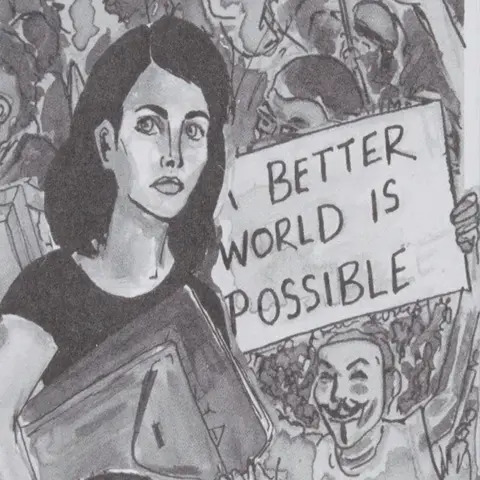
Thresholds Part 4: New Immigrants
Claudia Sadowski-Smith on the Post-Soviet migration to the United States
Aug. 12, 2026
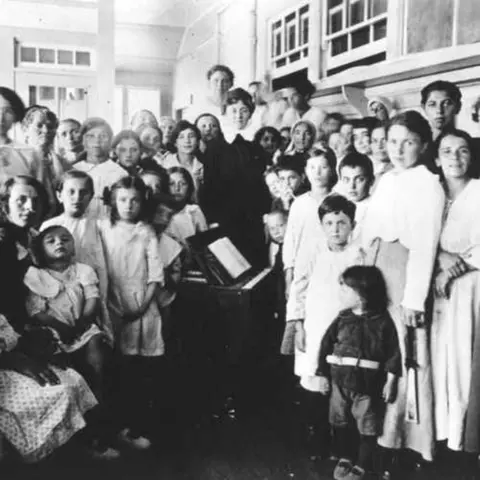
Thresholds Part 3: Russians in San Francisco
Nina Bogdan on the history of the Russian community in San Francisco

July 22, 2026
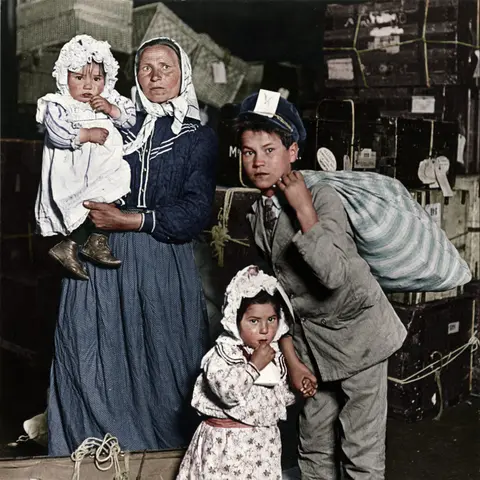
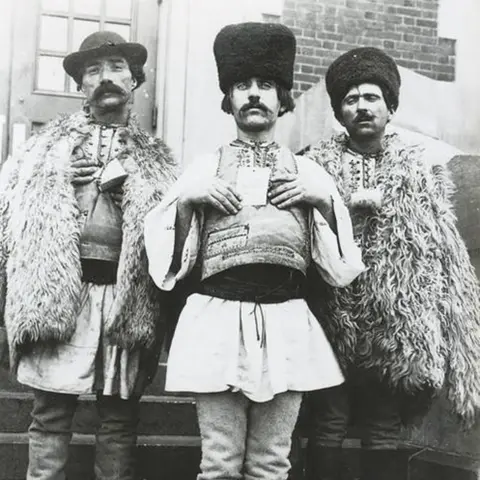
The Rise and Fall of the Georgian Democratic Republic
The Georgian Democratic Republic lasted a mere three years, from 1918-1921. And though it was viewed as an oddity at the time, many European social democrats marveled at its possibilities. Here was a state committed to social democracy in a mostly backward peasant and multiethnic country. What promises did it hold for the future? Unfortunately, the world never learned because the Bolsheviks crushed it in 1921 and proceeded to sovietize Georgia. The republic was denounced as counter revolutionary...

July 15, 2026
The Man Who Knew Russia
Everyone has an opinion about the late Russian historian Richard Pipes. Some loved him. Many hated him. He was a conservative and anti-communist. A hardliner on American policy toward the Soviet Union. Some would even say he was a Russophobe and cultural essentialist. But Pipes was a far more complicated figure. A Polish Jew whose family fled before the Nazis arrived, Pipes possessed a strong moral center that stood at the heart of his rejection of the USSR. He eventually applied his vision to h...

July 8, 2026
Reporting Russia's Descent
Marc Bennets has been reporting from Russia for over two decades. He’s covered Putin’s rise and consolidation of power, assassinations of oppositionists, mass protests, daily life, and even Russian football. It’s a storied career filled with zipping back and forth between Moscow and its regions. Marc also planted roots. He got married and became a dad. But then everything changed in February 2022 with Russia’s full invasion of Ukraine. Should he stay and keep reporting and risk arrest or worse? ...

July 1, 2026
Boris Nemtsov
On the night of 27 February 2015, assassins gunned down Boris Nemtsov as he crossed the Bolshoi Moskvoretskii Bridge. Shock quickly spread throughout Russia, particularly among its political opposition. Not because Nemtsov was so brazenly gunned down. Such are the risks of being politically active in Putin’s Russia. Nemtsov had been a fixture in the movement since its earliest days, and in many ways one of its founders. That such an internationally well-connected figure could be wiped out in cen...

June 24, 2026
The Last Soviet Artist
I met the graphic artist, Victoria Lomasko, about 10 years ago when she was a resident at the City of Asylum in Pittsburgh. I emceed an event with her back then. So I was happy when Victoria recently returned to the city to give a few talks at the University of Pittsburgh. Of course, the Eurasian Knot dragged her into a studio for an interview. A lot has changed for Victoria over the decade. Her graphic novel, Other Russias, represented the marginals of Russian society, and she won a Pushkin pri...

June 17, 2026
Remembering Alexander Rabinowitch
When I opened Facebook this morning, as I do every morning, I learned that Alexander Rabinowitch died at 91 years old. Rabinowitch was arguably one of the most important historians of the Russian Revolution. It's hard to state how much Rabinowitch's work influence our understanding of 1917. Before him, it was assumed that the Bolsheviks were a highly disciplined, unpopular political party that came to power through a coup. What Rabinowitch repeatedly showed in his four books on Revolution, the B...

June 10, 2026
Anastas Mikoyan
How Stalin personally ran the Soviet Union has rightly received much attention. Less discussed is the small group of men that served as his top lieutenants. They carried out his orders, and after his death, were instrumental in establishing the post-Stalin order. This week, the Eurasian Knot features a discussion with Pietro Shakarian about his new book Anastas Mikoyan: An Armenian Reformer in Khrushchev's Kremlin. We mostly know Mikoyan as a statesman and political survivor who successfully nav...

June 4, 2026
Soviet Holocaust Literature
It has long been assumed that there was no Holocaust memory in the Soviet Union. Official Soviet ideology lumped the 3 million Soviet Jews exterminated by the Nazis into the 26 million Soviet war deaths. So, the little Holocaust memory that existed was hidden away in families and communities. Recent scholarship, however, has painted a more complicated picture. Yes, official Holocaust memory was circumscribed. And, true, many privately commemorated its memory. But, as a new collection of Soviet H...

May 27, 2026
The Russian Paradox
Many studies focus on how Russia doesn’t work and why. There’s a laundry list of reasons. Corruption. Autocracy. Imperialism. Exceptionalism. But, how, then, does Russia work? Because there are people, a state, and society. What greases the wheels? Alena Ledeneva has made this question the focus of her career. For her, it’s the informal networks and practices that allow the system, with all its deficiencies, to function. Her new book, Russian Pendulum, is a synthesis of her three books on inform...

May 18, 2026
Kurt Vonnegut in the USSR
I went through my Kurt Vonnegut phase in my late teens. I read Player Piano, Cat’s Cradle, I think, Deadeye Dick, and of course, Slaughterhouse Five. I can’t say I remember much from those novels. Nor can I recall why Vonnegut connected with me. Perhaps now is a good time to revisit them. Little did I know that Vonnegut had a large readership in the Soviet Union. His books were translated by Rita Rait-Kovaleva and published in hundreds of thousands of copies. And in late Soviet fashion they were...

May 11, 2026
The Post-Soviet Human Condition
The Eurasian Knot hasn’t featured many philosophers. So when Ukrainian political philosopher, Mikhail Minakov, came to the University of Pittsburgh to give a talk, I eagerly pulled him into a studio. The result was a wide ranging conversation on the collapse of communism, the post-Soviet human, Kantian philosophy, our current global political conjecture, and the crisis of liberalism. What is a post-Soviet human and how does s/he differ from their Soviet counterpart? What are the seeds and expres...

May 4, 2026
Bye, Bye Orban
On April 12, 2026, Hungarians overwhelmingly voted Peter Magyar into office ending the sixteen-year rule of Viktor Orban. It was a stunning victory that sent voters into the streets to celebrate. Now, observers are looking to see whether Magyar will roll back Orban’s illiberal system and even prosecute Orban and his clients for corruption. Commentators will also watch now how the strongman’s defeat will reverberate in the region and what it might mean for rightwing authoritarianism throughout th...

May 1, 2026
The Georgian August 1924 Uprising
In August 1924, a group of rebels organized by the anti-Bolshevik Committee for the Independence of Georgia and led by the Georgian Social Democratic Party, rose up against Soviet forces in the mining town of Chiatura. The Bolshevik reaction was swift and harsh. The fear of another "Kronstadt” still haunted the Bolsheviks, especially since their control over Georgia was tenuous. The uprising failed. Thousands were killed. Its ringleaders either fled into exile or were executed by the Georgian Ch...

April 20, 2026
The Edge of Sports
Spoiler alert. This episode has nothing to do with the Eurasian Knot’s usual fare. Dave Zirin was speaking at the University of Pittsburgh. Zirin is one of the few sports journalists on the political left. I’ve been a long-time fan. I’m also a sports fan, especially basketball. So, when I was offered an interview, I grabbed my digital recorder. And Dave, though exhausted, was gracious enough to talk. The result is a wide ranging discussion of key issues in the sports world–politics, labor, race,...

April 6, 2026
Everyday Politics in Russia
What do Russians really think? The question is old and elusive. It is also somewhat of a tell–to pose it is to suggest there’s a coherent answer, and more so, that Russians’ collective opinions matter. For the most part, scholars have turned to history, media, opinion polls, and assumptions to untie this knot. Jeremy Morris is no different in this regard, except that he approaches his subjects with ethnography–long, multi-year conversations of residents of provincial Russia to gauge their engage...